

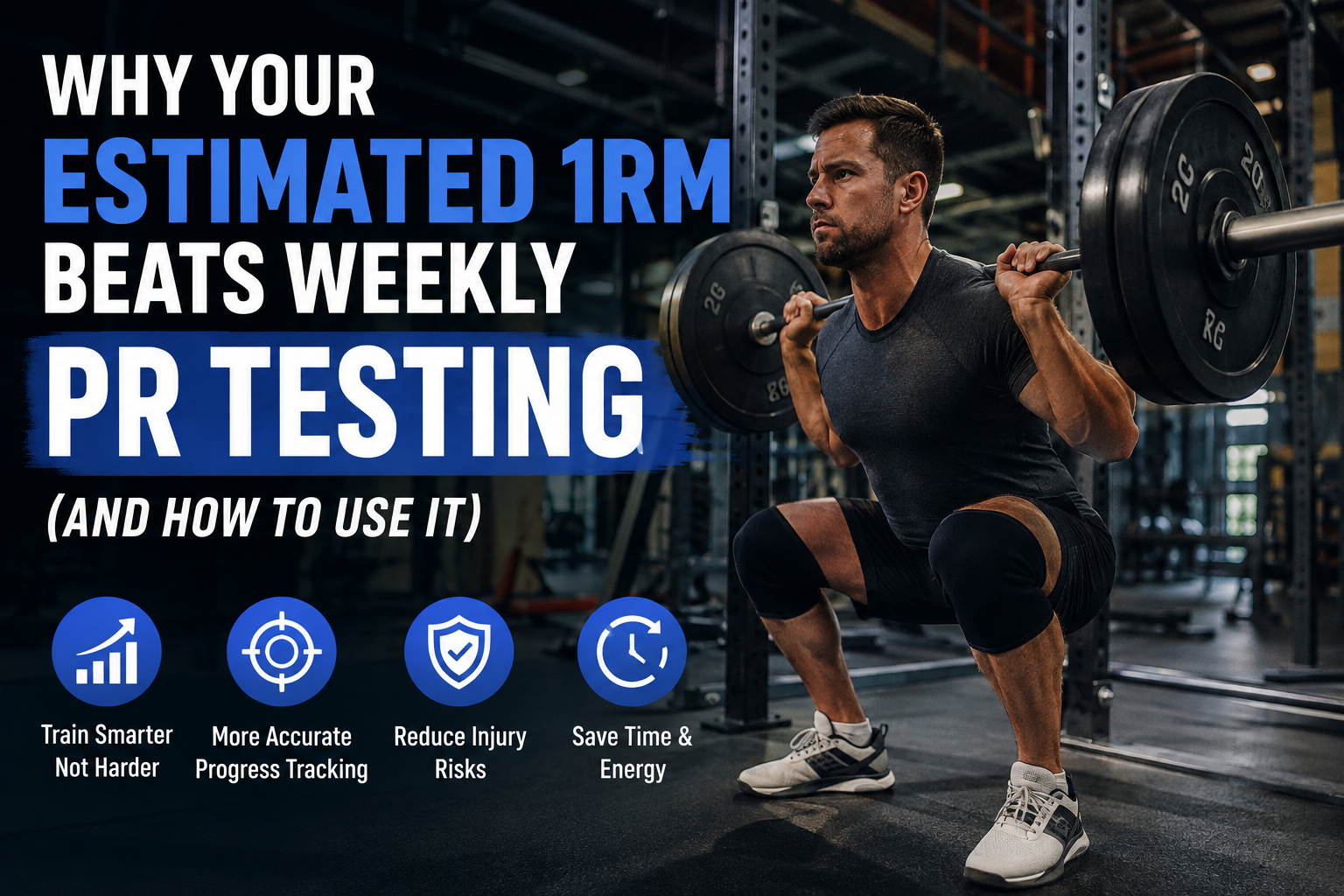
Walk into any gym on a Monday and you’ll see it: someone loading the bar to their absolute max, missing the lift, and walking away with nothing but a sore back and a bruised ego. I used to be that lifter. Every week I “tested” my bench press max, because how else would I know if I was getting stronger? The truth is, I was skipping proper Warm-Up Routines and treating every workout like a max-out session instead of focusing on steady progress and proper preparation.
Here’s what a few years of lifting — and building a workout tracking app used by thousands
of lifters — taught me: testing your one-rep max every week is one of the most reliable ways
to stop making progress. The lifters who actually get strong track an estimated 1RM instead,
and test the real thing only a few times a year.
What an estimated 1RM actually is
Your one-rep max is the heaviest weight you can lift once with proper form. But you don’t
need to attempt it to know it. Two formulas, both decades old, predict it from any hard set:
Epley: 1RM = weight × (1 + reps ÷ 30)
Brzycki: 1RM = weight × 36 ÷ (37 − reps)Bench 100 kg for 5 reps and Epley puts your max at roughly 117 kg; Brzycki says about 112
kg. The truth is usually between them, which is why good calculators average the two.
For sets under 10 reps, these estimates land within a few percent of reality. Past 10-12 reps
the math gets fuzzy — muscular endurance starts doing the work instead of pure strength —
so estimate from your heavy sets of 3-8.
Why weekly max-outs backfire
Three reasons, all of which I learned the hard way.
First, true max attempts are brutally fatiguing. A 1RM attempt stresses your nervous system
far more than a heavy set of five, and that fatigue lingers for days. Test every Monday and
you’re sabotaging Wednesday and Friday — the sessions where growth actually happens.
Second, max attempts at the edge of your ability are where form falls apart. Nearly every
lifting injury story starts with “I was going for a PR.” The risk is worth it occasionally. Weekly,
it’s a subscription to getting hurt.
Third — and this is the one nobody talks about — a failed max tells you nothing. Missed 140
kg today? Maybe you’re weaker. Maybe you slept badly. Maybe it was your third week of
testing and you’re fried. There’s no signal in it, just noise and frustration.
The feedback loop that actually works
The alternative is simple: log your top working set each session, calculate the estimate, and
watch the trend.
Say you benched 100×5 last week (estimated max ~114) and 102.5×5 this week (~117).
You just got measurably stronger — without a single max attempt, without the fatigue,
without the risk. Your training told you the answer as a by-product of doing the training.
This is the entire reason I built my tracker around the estimated 1RM: when every logged set
updates the estimate automatically, progress stops being a feeling and becomes a number
you can watch move week over week. But you don’t need an app — a notebook and the
Epley formula work. The principle is what matters: measure the trend, not the peak.
Then, every 8-12 weeks, test for real if you want to. Treat it like a powerlifter treats a meet:
deload the week before, warm up properly, make singles at 90%, 95%, then a small PR
attempt. Testing this way is safe, accurate, and genuinely exciting — because the trend
already told you it’s going to move.
Programming off your estimated max
Once you have a current estimate, it becomes the anchor for your whole program:
Strength work: 3-5 reps at 80-90% of your estimated 1RM
Volume / hypertrophy: 6-10 reps at 70-80%
Technique and speed: 60-70%
If your program says “squat 5×5 at 80%” and your estimated max is 140 kg, you load 112 kg.
No guessing, no ego. As the estimate climbs, the percentages climb with it — progressive
overload happens almost automatically.
The estimate is also an early-warning system. If it drops two weeks in a row, you’re not
suddenly weak — you’re under-recovered. That’s your cue to deload, sleep more, or eat
more, weeks before you’d otherwise notice you’re grinding.
The takeaway
Chasing a weekly 1RM feels productive, but it trades your recovery, your joints, and your
progress for a number that’s mostly noise. Estimate it instead: lift hard in the 3-8 rep range,
run the formula, watch the trend, and save the real max-outs for a few well-earned test days
a year. You’ll be stronger on those days than the weekly tester ever gets — I’ve watched it
happen in my own training and in the data of thousands of lifters since.
Pasha Mor is a lifter and the developer of 1RM.fit, a free workout tracker that calculates your
estimated 1RM automatically from every set you log.